
 |
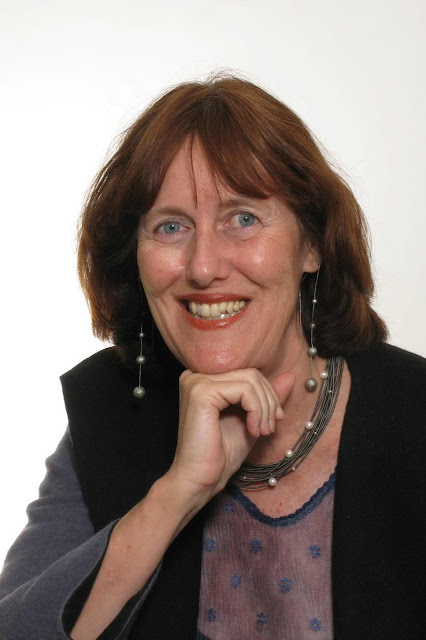
| Willeke Wendrich, director of UCLA's Cotsen Institute of Archaeology |
In my previous post, I reported that University of Santa Barbara, California archaeologist Danielle Kurin had abruptly resigned her tenured position in the UCSB anthropology department in early January--an action that is being widely celebrated in the department and in the anthropology and archaeology communities Kurin was supposedly part of. That's because Kurin's abuses of students over many years, which included retaliation, bullying, and exploitation of young researchers for her own benefit, were very well known, and at the same time enabled by so many individuals and institutions.
In that earlier post, I argued that it was time to begin calling Kurin's enablers to account, and I went into some detail about who the major enablers were and what they had done. As many readers here will know, in June 2020 Kurin sued me for $18 million in defamation damages. The case dragged on for 13 painful months before it was settled, and then unsettled, as it were, after Kurin violated the agreement we had come to.
During the discovery phase of the litigation, my attorneys and I received roughly 4000 pages of documents concerning Kurin from UC Santa Barbara and the Los Angeles-based Institute for Field Research, on whose academic board Kurin sat from 2016-2018 and which sponsored some of her field schools in Peru. About half of those pages were from UCSB and half from IFR. However, as I have mentioned in earlier posts, both institutions insisted that the documents be put under a court protective order, such that they could not be published and could only be used in the lawsuit. To avoid months of litigation over this unjustified attempt to hide documents that were clearly in the public interest from being revealed, my attorneys and I agreed, pending motions to the federal judge in the case to release them.
While I am obviously not allowed to reveal the contents of the documents, I can say that they backed up my reporting 100%, and that there was absolutely no privacy or other justifications for their being kept secret. Nevertheless, when the case settled and the judge dismissed it with prejudice, the court order required that the documents be destroyed and deleted.
However, the protective orders we signed with UCSB and IFR included the following language:
"Nothing herein shall affect or restrict the rights of any party with respect to its own documents or to information obtained or developed independently of materials afforded confidential treatment pursuant to this Order."
Of course, before the lawsuit was filed and before these protective orders were signed, I had independently developed many sources and obtained access to many documents concerning how UCSB and IFR handled the Danielle Kurin matters, and I continued to do during the lawsuit--and I continued to do so after the lawsuit was dismissed. So while I obviously cannot "forget" what I read in the protected discovery documents, I am also free to report on information I have developed on my own. Over the past months, I have done just that; and fortunately, after everything that has happened, new sources, at both IFR and UCSB, have been willing to talk to me and to provide me with documents independently of the discovery materials. At the same time, I have filed a series of California Public Records Act requests for documents held by UCSB and UCLA, and those are now starting to be produced, with minimal redactions.
Because of the sensitivity of the sourcing for what follows, and the need to protect individuals who fear either retaliation or chastisement from their peers, I am going to be careful how I attribute the information I will lay out below. However, everything I will say is confirmed by individuals who were present for the events discussed, and by documents, including IFR board meeting minutes, emails, and other material.
While I will be quoting out of the documents, I will not be posting them here. For reasons I will not discuss, doing that could possibly identify who gave them to me, or at least provide clues to those who might want to retaliate against those sources. All reporters should be mindful of how careless handling of documents helped send NSA whistleblower Reality Winner to jail, a mistake The Intercept has yet to take full responsibility for.
What the documents and sources demonstrate is that Willeke Wendrich, director of UCLA's Costen Institute of Archaeology and chair of the IFR governing board, lied to me, some of her colleagues, UCLA students, and others about what she and the IFR board knew about Danielle Kurin's Title IX proceeding at UCSB in 2016. In fact she and the IFR governing and academic boards knew no later than October 2016 that Kurin had been subject to a Title IX and had been put on administrative leave.
Why did Wendrich and others lie about it? There may be multiple reasons, but fear of litigation by victims and survivors of Kurin's retaliation and her husband's sexual harassment was clearly one of them. I will have more to say about that as I report on this new investigation.
A chronology of coverups and lies.
From a moral point of view, it matters not just that someone has lied, but who they lied to. The first batch of documents I received from UCLA consists of 41 pages of emails to and from Richard Lesure in May and June of 2020, shortly after I first reported about a sexual assault and other incidents at Kurin's 2018 IFR-sponsored field school in Peru. Lesure is an archaeologist at the Cotsen, and has also served as an advisor to IFR. Upon reading this reporting, on May 29, 2020, graduate students at the Cotsen Institute wrote a letter to Wendrich and other faculty expressing concerns about the allegations and asking for answers to a number of questions. (I earlier quoted a short section of this letter; the entire text is reproduced in the Lesure emails.)
In response, Lesure, Wendrich, and other Cotsen faculty convened a "Town Hall" meeting with the students on June 11, 2020, which included various UCLA officials including a dean and the head of the Title IX office. I reported in detail on this Town Hall, based on sources at the meeting and a recording that was made of it, shortly afterwards. At the time of my original report, Wendrich insisted that neither she nor the IFR board knew about Kurin's Title IX back in 2016, and accused me of "unethical" reporting for saying that they did. Wendrich and others repeated these falsehoods at the Town Hall. And in the Lesure emails, we read the following, where Wendrich clearly lies to her own colleagues:
From: Wendrich, Willeke [mailto:wendrich@humnet.ucla.edu]
Sent: Tuesday, June 2, 2020 11:13 AM
To: Richard Lesure <lesure@anthro.ucla.edu>
Cc: Jason De Leon Glenn Wharton <glennwharton@ucla.edu>;
Greg Schachner <gschachner@anthro.ucla.edu>
Subject: RE: Update for/consultation with Cotsen Institute Advisory Committee
Richard,
I’m afraid we cannot put on the agenda: “faculty affiliated with the IFR invited to respond to
allegations in Michael Balter’s blog”. The term “respond to allegations” is problematic, because
those allegations are not against UCLA faculty affiliated with IFR. I am willing to discuss why his blog
is misleading and what Balter’s methods are. That would be an important learning point for the
students. The only “allegation” that concerns me directly is that I supposedly lied when I told Balter
that I or the IFR board did not know that Kurin was on administrative leave because of Title IX
allegations. I did not know and I did not lie. There is really not much more to say about that. Perhaps
reframe as “discussion of Michael Balter’s blog and methods”
Thanks,
Willeke
This false statement was consistent with what Wendrich told me while I was reporting on these events in 2020:
Michael,I am thoroughly disappointed with your lack of journalistic ethics. You are publishing falsehoods. IFR was not aware of any title IX investigations and accusations prior to the 2018 field school. I made this very clear in our email conversation.Willeke
Now let's look at the facts. For the benefit of easy comprehension, and for those who are new to this story, I will take a chronological approach.
2014-2016: As I reported on this blog in 2020, after the defamation suit was filed, the UCSB administration received reports of abuse and bullying of students by Kurin beginning in 2014, the first year of her tenure track position. Two of these stories can be found here and here. And beginning in September 2015, the UCSB Title IX office received complaints from students who said they had been sexually harassed by Kurin's partner and later husband, Enmanuel Gomez Choque. In early 2016, the university opened a formal Title IX investigation and put Kurin on administrative leave pending its outcome. The UCSB administration, however, kept these proceedings secret from the anthropology faculty, except for the department chairs, who were told not to tell anyone what they knew.
June 14, 2016: The Title IX office issued its report, which concluded that, based on a preponderance of the evidence, Gomez had engaged in sexual harassment and Kurin had retaliated against students who reported it. At that time, Kurin had proposed to IFR that they sponsor field schools in Peru that she was holding again that year, and IFR had agreed to do so. There is no evidence that Kurin ever told IFR that she was under active investigation for misconduct, and there is no evidence that IFR knew before this time.
June 16, 2016: While IFR was the sponsor of the scheduled field schools in Peru, which were to begin in July, formal academic credit was given through UCLA Extension. Sometime between June 14 and June 16, according to sources, the dean of academic affairs for UCLA Extension (and later IFR board member) Kevin Vaughn, himself an anthropologist, was told of the Title IX findings. On June 16, Vaughn and then IFR executive director Ran Boytner wrote to the students who had signed up for Kurin's field schools and told them that they were cancelled due to "health and safety reasons."
According to sources, Vaughn was aware at that time of the Title IX findings against Kurin and Gomez. Exactly what he told Boytner at that time is not clear. But at some point between then and October 2016, Boytner did become aware that Kurin had been subjected to a Title IX, and reported that to the IFR board at a joint meeting of its governing and academic boards. The following is based on multiple sources who were present at that meeting, and other documents including minutes of the meeting. Given the obvious sensitivity of the sourcing, I will have to be careful about how I describe this so as not to compromise both the sources who were there and those who provided me with these documents, independent of the discovery in the defamation case. But it is gratifying that some individuals who might have been inclined to protect IFR's institutional interests earlier no longer see that as the highest priority, given the evidence of lying by Wendrich and the subsequent events concerning Danielle Kurin. Importantly for the purposes of accurate reporting, the eyewitness accounts correlate exactly with what was recorded in the meeting minutes.
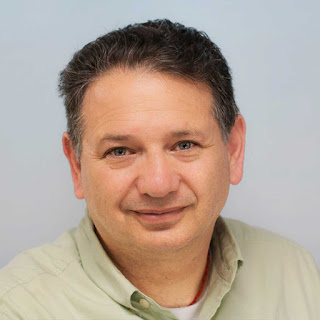 |
| Ran Boytner |
October 7 and 8, 2016: Joint meeting of IFR's governing and academic boards.
This meeting took place at the IFR's offices in Los Angeles. Among those attending:
Governing board members: Willeke Wendrich (UCLA), Lynn Swartz Dodd (USC), Fred Limp (U of Arkansas), Anthony Graesch (Connecticut College), Yuval Bar-Zemer (industrial developer.)
Academic board members: Danielle Kurin (UCSB), Charles Stanish (former Cotsen director), Tim Williams (University College London), Barra O'Donnabhain (University College Cork), Benjamin Porter (UC Berkeley), Alex Fisch (Mayor of Culver City, CA.)
Also present were IFR executive-director Ran Boytner, some IFR staff members, and the institute's legal counsel, John Given, as well as David Goldman, the program director for humanities and social sciences at UCLA Extension.
On the second day of the meeting, October 8, Boytner led a session called "The State of the IFR." Among the topics were "programs with issues," of which two were identified at the meeting: Kurin's field school at the site of Sondor in Peru, and a sexual assault case at the IFR's field school at Prane Siddi, Italy.
Few details were given at the meeting about what happened at Prane Siddi, but it does appear from the minutes of the meeting that IFR was taking it seriously and working with the director, Emily Holt, to insure that students would be safe the following year.
On the other hand, the discussion of Kurin's Title IX was extensive. Boytner told those gathered that Kurin's July field school had been cancelled due to a Title IX investigation, and that UCLA Extension had paid for the "consequences" of that last-minute action (according to sources, reimbursing the students for fees, flights, and other expenses.) Boytner, who according to those present was very supportive of Kurin, told the gathering, according to the minutes, "allegation is not proven, unknown what the allegation is."
But Kurin, who was present at the meeting and acknowledged the Title IX, lied to the board members about the charges and also about the status of the investigation. She told colleagues that the investigation was ongoing, that UCSB had not really told her what the charges were, and--as she would repeat far and wide over the years, up to the present--that the allegations had been brought by "racist gringas" who were bigoted against Gomez (by this time Kurin and Gomez had married at a ceremony in Santa Barbara; they were also married in the Peruvian church the previous year, September 2015.)
Kurin also explicitly told everyone that she was on administrative leave (contra Wendrich statements above.)
Of course, Kurin knew full well what the charges and the findings were, because she received the Title IX report right after it was finalized on June 14, 2016. Nevertheless, she offered to resign. This brought about a motion, which, according to the minutes of the meeting, was proposed by Fred Limp and seconded by Charles Stanish, declining Kurin's offer of resignation and keeping her on the academic board. The motion carried unanimously.
The meeting also addressed the strong opinion of Boytner and Wendrich that, pending the outcome of the Title IX investigation that was actually completed, Kurin be allowed to offer her field school in 2017. However, Kevin Vaughn (who was not present at the meeting) had earlier communicated to the IFR board that UCLA Extension would probably not allow academic credit for it in subsequent years, and David Goldman of UCLA Extension, who was present, was apparently unable to clarify the situation. At that point Wendrich insisted that "IFR should go forth with the Field School with or without credits from UCLA Extension," according to the minutes. (In fact, that is exactly what happened; in 2018, the field school was held under IFR sponsorship with academic credit from Connecticut College.)
The minutes also reflect concerns that without Kurin's field school, IFR was in a worse financial position. The minutes quote developer Yuval Bar-Zemer as saying, "marketing-wise it was excellent, filled completely, super popular; what measures can we add to the program to protect us legally?"
Of course, as we now know, the Title IX was only the first step in Kurin's disciplinary proceedings, which went on until early 2018. At that time, as part of a settlement with UCSB, she signed a "Letter of Censure" which found her culpable of multiple counts of misconduct; the settlement allowed her to come back to work after a full three years of administrative leave was completed, provided that she did not offend again and that she complete a lengthy course of psychotherapy. (The Letter of Censure is now a public document; my other statements are based on sources familiar with the settlement terms.)
According to sources present at this meeting, the board members showed an odd lack of curiosity about what Kurin had actually been charged with, and seemed to accept her explanations at face value--even though then, as now, a Title IX most often involves sexual harassment or misconduct of some kind. There was also no apparent discussion of Kurin's partner Gomez, although Boytner and some board members were likely to be aware that he was playing a major role in the field school.
As an example of how much benefit of the doubt Kurin was given, even though UCLA Extension had abruptly cancelled the 2016 field school for "health and safety reasons," no one at the meeting reportedly expressed concern for student safety--the main concerns discussed were financial and legal. Even more: a motion to appoint Kurin to the IFR Merit Based Scholarship Committee (proposed by Wendrich) passed unanimously.
October 20-21, 2017: Joint meeting of the IFR governing and academic boards.
By the time of this meeting, Kurin had held her summer field school in Peru, albeit without academic credit for the students attending. As I have reported earlier, there were again incidents of sexual harassment by Gomez, and Kurin repeatedly offered marijuana to the students in an apparent effort to placate them, thus putting them in potential serious danger with Peruvian police. However there were no formal complaints made, although the students did share their experiences with others.
A full year had now gone by since the last joint board meeting. Yet the minutes of the 2017 meeting do not reflect any updates, or even discussion, of Kurin's Title IX proceedings. Perhaps during this time, Wendrich and some other board members were privately briefed on what that case was really about. Or, just as likely according to the evidence, they did not really care. At the academic board portion of this meeting, Kurin was appointed to three more committees: The Opportunity Scholarship Review Committee (seconded by Wendrich); the Merit Based Scholarship Review Committee (seconded by Wendrich); and the Post Board Meeting Academic Review Committee (seconded by Wendrich.)
We also read Motion 11 at the meeting: "Having conducted due diligence of the Peru-Sondor project, we--the IFR Academic Board--express our desire to continue working with Dr. Danielle Kurin as the director of IFR field school(s). Proposed by Wendrich, motion adopted.
March 2018: Kurin signs the settlement with UCSB, mentioned above, in which she agrees to accept responsibility for her misconduct in a "Letter of Censure" which is put in her personnel file for three years.
April 17, 2018: IFR executive-director Ran Boytner writes an email to the IFR boards and IFR staff to announce that Kurin has come to an agreement with UCSB. Botyner states in part:
"I meet [sic] with Danielle Kurin at the [Society for American Archaeology meeting] and am delighted to share with you that the dispute with UCSB is now resolved. Danielle is a functioning officially active Assistant Professor there. How and why is confidential but Danielle shared with me that she will begin teaching classes again at UCSB on [sic] April 2019." (Kurin actually returned to work that fall.)
Boytner adds: "As we all know, the past two years were a trying period for Danielle," and goes on to list all the things she did over that time instead of sitting "idle."
At least one member of the board, Jason De Leon of UCLA, responded to Boytner's email, saying, "excellent news!" I have not yet talked about De Leon in this post, but in my report on the Cotsen Town Hall I pointed out that he was likely to have been aware of the Title IX from the beginning, and also that he lied about his knowledge--at the same time he was publicly attacking me for supposed false and unethical reporting.
What can we conclude so far? That the IFR governing and academic boards knew that Kurin was subject to a Title IX, knew that she was still on administrative leave, and nevertheless asked very few questions about it all (at least that they shared with their colleagues.) Did Wendrich and Boytner know what the actual charges were, based on their relationship with Kevin Vaughn and other colleagues who did know? Did they discuss any of this with UCSB officials, in an attempt to protect students in their field schools?
What we can conclude, beyond any doubt, is that they lied about what they knew. And, that their actions allowed the following to happen:
July 2018: A student is allegedly sexually assaulted by Gomez, Kurin's then husband, at her IFR sponsored field school. After threatening retaliation against students if they reported it, Kurin sees the writing on the wall and reports it herself to Boytner. After a very slow start, IFR begins an investigation which lasts until that October. It includes interviews with the sexual assault victim and other witnesses.
October 2018: IFR's investigations concludes that there was misconduct at the 2018 field school. Kurin is banned from holding field schools and she is removed from the IFR academic board.
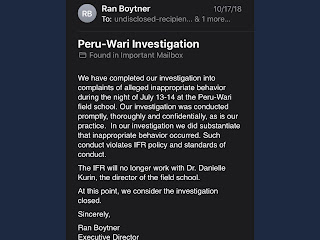 |
| Boytner's message to 2018 field school students |
Motions are proposed and adopted to send out letters about the investigation's findings to certain parties (not named.) Actions are proposed to improve IFR's handling of sexual harassment issues, including sexual harassment training for all field school directors and discussion of sexual harassment guidelines with students at the beginning of each school.
Last item on the agenda: Send a thank you letter to Danielle Kurin.
September 2018: [Note slight switch in chronology]
According to multiple sources, Kevin Vaughn began discussing privately with numerous colleagues what had happened at Kurin's 2018 field school. Some faculty, considering themselves mandatory reporters, informed the UCSB Title IX office. That office reportedly takes no action; likewise, in 2020, UCSB's Title IX office receives numerous complaints from students and faculty, again declines to take any action.
There is no evidence whatsoever that Wendrich or any IFR board member or official informed UCSB of its findings and Kurin's removal from all activities with the organization. Did they violate their own responsibilities as mandatory reporters?
June 2020: Kurin sues me for defamation. July 2021: Case is settled and dismissed.
Jan/Feb 2021: UCSB anthropology department recommends against her receiving tenure.
August 2021: UCSB Chancellor Henry Yang overrules department decision, awards Kurin tenure.
January 2022: Kurin abruptly resigns, claiming that she was searching for a more "meaningful" job and that it had nothing to do with the latest revelations concerning her apparent misconduct in the Jack Cantin case.
Conclusions: Danielle Kurin's misconduct, as I have argued repeatedly and most recently in as much detail as I could, could not have taken place--nor could should have hurt the numerous students she victimized over the years--without being enabled by those who had the power to stop her. I can only hope that this latest report will help bringing those enablers to account.
Kurin may be gone from UCSB, but this story is far from over. I will continue to report as always.
Note: I have invited Wendrich and De Leon to respond to or comment on this report and I will publish what they say, if anything, in full.

![The truth at last, or at least some of it, about Peter Rathjen, the U of Adelaide, the U of Melbourne, the U of Tasmania, etc. [Updated Sept 3, 2020: University of Melbourne "leader" finally speaks]](https://blogger.googleusercontent.com/img/b/R29vZ2xl/AVvXsEhTTYlLfJJPciFfe5iknlB2hbK8jYC5SDgoJTGaFKZBvgKVDAjUHzXjHFifYPzrixQgmQPW0Udsk6Y3OMLjmJd4rCxY352IA9Nwt2DlSscScArhuGqGpsiLozqx1A2xzK2I0_u_HOjwQlfn/w680/Rathjen.jpg)


65 Comments
Thank you for this thorough reporting. In that cited Town Hall, the Cotsen Institute graduate students also asked Wendrich about Boytner’s own sexual misconduct history and sexist, racist and bullying behavior at UCLA and IFR. She similarly denied knowledge, but in light of the above it may be worthwhile to check if she lied there too. Ironically, both Wendrich and De Leon further claimed in that meeting that they learned about it from Balter’s blog. Eventually it was Lesure who volunteered information about an even earlier case where Boytner bullied another female student while he was a TA in his class in 1996. Many now consider Boytner’s own 2009 Title IX investigation and following lawsuit to be the real reason behind his termination from UCLA, and it was suggested that this was also the reason why he was so sympathetic and supportive of Kurin in the first place.
Perhaps not surprising, there is another emerging pattern here. According to Kurin’s CV that she used in her tenure package, she currently has two “Works In Press/Progress” with Cotsen Press (copied below), of which Wendrich is the editorial director.
Someone also mentioned in a previous post that in her new book acknowledgments, Kurin writes how she “benefitted from the wisdom of… Ran Boytner, Hans Barnard, and Chip Stanish”. Now that we start to realize how deep this deception goes, I wonder what “wisdom” she was referring to exactly.
“Works In Press”
YR: 2021
Title & Author(s): D.S. Kurin, V. Black°, B.M. Lizarraga°, I. Robledo°. Rumors of war and warrior realities in ancient Peru.”
In Archaeology Outside-the-Box,
H. Barnard, editor. [PUBLICATION SCHED: 1 ST QTR 2021]
Publisher: UC Los Angeles: Cotsen Institute Press [AWAITING PROOFS]
Category: Chapter
“Works In Progress”
Title & Authors: Paleopathology:
For: Elements of contemporary archaeology series
W. Wendrich & H. Barnard, series editors.
Potential Publisher: Cambridge University Press & UCLA: Cotsen Institute Press
STATUS: Finalizing Contract & Planning
PUBLICATION ANTICIPATED: FALL 2023
Cat.: Book
“ Of course, Kurin knew full well what the charges and the findings were, because she received the Title IX report right after it was finalized on June 14, 2016. Nevertheless, she offered to resign. This brought about a motion, which, according to the minutes of the meeting, was proposed by Fred Limp and seconded by Charles Stanish, declining Kurin's offer of resignation and keeping her on the academic board. The motion carried unanimously.” They proposed and unanimously approved the motion to REFUSE Kurin’s offer of resignation. Let that sink in. They FOUGHT to keep her in good standing with the IFR, leading to further abuses.
“ October 13, 2018: Meeting of the IFR Board of Governors.
Motions are proposed and adopted to send out letters about the investigation's findings to certain parties (not named.) Actions are proposed to improve IFR's handling of sexual harassment issues, including sexual harassment training for all field school directors and discussion of sexual harassment guidelines with students at the beginning of each school.
Last item on the agenda: Send a thank you letter to Danielle Kurin.” Send a non ironic thank you letter to Kurin after spending the whole meeting dealing with the fallout of her and Gomez’s actions?!?!?! It’s clear where their sympathy lies, not with the survivors and victims. UGH
1. “those allegations are not against UCLA faculty affiliated with IFR”
2. “I did not know and I did not lie.”
3. “I am willing to discuss why his blog is misleading and what Balter’s methods are”
4. “reframe as “discussion of Michael Balter’s blog and methods”
Though the winning line is surely this: “That would be an important learning point for the students”
It sure was.
It might seem that with Kurin’s resignation, this story is now at an end. Actually, it is just beginning: UCSB’s complicity, IFR’s and Cotsen’s complicity, the Jack Cantin case, etc. Kurin is just one abuser among many. But the powerful people who helped her get away with it are now in the spotlight.
This was 601 days ago, and counting.
Wendrich disclosed on record that as a nonprofit IFR does not need to comply with title ix regulations, nor will they make public statements about abusers because of litigation risk. This immediately made us all wonder what else may have happened in those field schools that we are not aware of.
Wendrich disclosed on record that as a nonprofit IFR does not need to comply with title ix regulations, nor will they make public statements about abusers because of litigation risk. This immediately made us all wonder what else may have happened in those field schools that we are not aware of.”
There was this revelation from their minutes:
“ On the second day of the meeting, October 8, Boytner led a session called "The State of the IFR." Among the topics were "programs with issues," of which two were identified at the meeting: Kurin's field school at the site of Sondor in Peru, and a sexual assault case at the IFR's field school at Prane Siddi, Italy.”
Clearly Kurin and Prane Siddi were only the tip of the iceberg.
It’s only defamation if it’s false.
“Anonymous said… February 3, 2022 at 11:42 AM
Clearly Kurin and Prane Siddi were only the tip of the iceberg.”
Same field school?
https://www.fieldsciences.org/program/italy-pane-siddi-2022/
Except that now the PI is the Board Member & Executive Director of Boytner’s new business venture:
https://www.fieldsciences.org/board-of-directors/
Isn't that an interesting coincidence?
It seems that student safety at these field schools is no one’s business and that all information related to it can be kept secret.
Students beware. Profs, exercise due diligence in field schools you recommend to your students.
Unfortunately, I think all of these individuals are aware of the UCLA/IFR issues at this point, and certainly aware of Ran Boytner’s history. Those issues are very widely known in the archaeology community. But it has not changed their choices. That is the very sad part.
Lesure’s reply to Wendrich’s email quoted above proves that not all UCLA faculty are delusional liars and that there is still hope at the end of those underground tunnels.
“From: Richard Lesure
To: Wendrich, Willeke
Cc: Jason De Leon; Wharton, Glenn; Greg Schachner
Subject: RE: Update for/consultation with Cotsen Institute Advisory Committee
Date: Tuesday, June 2, 2020 11:41:00 AM
Attachments: image001.png
image002.png
Dear Willeke,
Hmmm. I wonder if the discussion may go very differently from what you expect. There might also be questions from faculty as well. It seems to me that you are indeed being asked to “respond to allegations in Michael Balter’s blog”—see the graduate student letter of May 29. “Discussion of Michael Balter’s blog and methods” doesn’t seem to doesn’t seem to quite capture the issue.”
I also appreciate how he and Smith ensured that the identity of the 19 concerned students is not compromised, and in fact derailed Wendrich’s attempts to “resolve” the matter through a next-day “private” Zoom with the students which of course would have immediately exposed them, or by slapping it on their already busy faculty end-of-year meeting. Brava/o!
"Sexual assault and safety were also big concerns"
You know, in case the subliminal messaging in the text wasn’t enough. Just ridiculous.
@ Anonymous February 4, 2022 at 11:11 PM
I hear you and agree that it’s becoming more and more challenging to find quality /and/ safe field training for our students. Maybe you knew more when you declined Boytner’s initial request, but for many of us IFR was supposed to be the answer …. before it turned into this fucking shit show.
I’m not sure which of the new board members you allude to, but those that I know and respect(-ed) for sure know about IFR/UCLA. Some simply elected to ignore collegial advice when they joined, other elected to follow the advice of their implicated friends’ at UCLA (which is why they didn’t just say no to Boytner). This sort of pretense may have been passable a few years ago when most of the information needed to make an informed decision was still circulating in dark bars at the SAA’s after-hours. It is absolutely /not/ justified these days, when everyone can easily google and fact-check much of what was already published here and elsewhere. Archaeologists are really a weird bunch. They will voluntarily spend huge amounts of time to travel to the end of the world just to prove their preconceived ideas, but fervently refuse to click on a five-minute-read that will prove beyond doubt that they were wrong all along.
Q: “There is no evidence whatsoever that Wendrich or any IFR board member or official informed UCSB of its findings and Kurin's removal from all activities with the organization. Did they violate their own responsibilities as mandatory reporters?”
A: Yes.
ICYMI: this latest blog post reveals yet another convoluted plot amongst the enablers.
The Cotsen press book manuscripts discussed at the end of the linked Cotsen email exchange, must be the same one on Kurin’s latest CV (with thanks to “Anonymous said… February 1”)-
“Works In Press”
YR: 2021
Title & Author(s): D.S. Kurin, V. Black°, B.M. Lizarraga°, I. Robledo°. Rumors of war and warrior realities in ancient Peru.”
In Archaeology Outside-the-Box,
H. Barnard, editor. [PUBLICATION SCHED: 1 ST QTR 2021]
Publisher: UC Los Angeles: Cotsen Institute Press [AWAITING PROOFS]
Category: Chapter
If so, this is the SAA 2019 session that the book is based on (again- with thanks to various colleagues who pointed this out)-
https://core.tdar.org/collection/69439/archaeology-out-of-the-box-investigating-the-edge-of-the-discipline
Boytner gave the introduction to the session, as also the discussion on the Cotsen book suggests. Jason de Leon also participated in the SAA session (and the book?)
Noticeable though, Kurin was not part of this session. This indicates that she was invited to contribute to the publication only after April 2019, that is long after she was found responsible for the summer 2018 events and banned from the IFR.
I am as equally perplexed as those in the email exchange as to why Hans and Willeke will choose to invite and include her in the book, knowing what they already knew about her at the time. Mind you, Kurin used this “work in progress” for her tenure application so they must have known that including a serial abuser in this book is also enabling her access to more students.
I think that Darnell Hunt and the other UCLA officials that participated in the Town hall should demand that Hans and Willeke explain themselves.
The graduate students showed their mettle when they insisted on answers and the Town Hall was organized. Now that they know they were lied to, they have agency and choices to make too—it’s not just up to the faculty and the administration. The students are at very vulnerable points in their careers, but there is a lot at stake for them. Will there be consequences for Wendrich and De Leon for deliberately misleading the community? (I include De Leon because it is not credible that he did not read the minutes of the IFR board meetings even if he was not at the October 2016 gathering.)
Anyone involved in this who wants to talk to me, as the reporter who is covering this, can do so in complete confidence. But let’s make sure that everything that happens going forward is public and not behind closed doors.
Booo!
https://www.chronicle.com/article/3-women-accused-a-harvard-anthropologist-of-harassment-and-retaliation-now-theyre-suing?utm_source=Iterable&utm_medium=email&utm_campaign=campaign_3673894_nl_Academe-Today_date_20220209&cid=at&source=&sourceid=
https://www.chronicle.com/article/they-signed-a-letter-in-support-of-a-colleague-now-they-want-to-take-it-back
https://www.documentcloud.org/documents/21201049-comaroff-retraction-letter-new
It’s the same old story over and over again. Those distinguish faculty only listen to their colleague version of events, and then act all surprised when the truth (which has been known for years) “hits” them in the face. I mean, what did you expect the offender to say? This is precisely how Kurin persisted for so long and why Boytner is still around. Like Dr. Kristen Hillaire Glasgow — who sued UCLA for botching another sexual harassment case, and won – just remarked:
“It takes a Westwood Village to harbor sexual predators” (the Bruins will get it).
There's a breaking story on the Cal State University system's Chancellor Castro.
https://www.fresnobee.com/opinion/opn-columns-blogs/marek-warszawski/article258141588.html
RE Jason De Leon’s redacted email address, he truly deserves that Genius Award!
Basically using a personal account in official business often serves to keep “sensitive” matters off the institutional radar, particularly in cases where concerned citizens or journalists (or lawyers) will one day request a California Public Records Act.
Like, you know... ^^^ ...
(The IFR executive board tried this trick once when they emailed an "official" letter to the field directors, in which they also opted for Gmail or other non-edu. emails. Can’t find it now, but Balter reported on it somewhere on this blog)
Maybe the SAA leadership needs to be directly informed of all this?
SAA leadership will do nothing. Fred Limp, above-mentioned as the one proposing to decline Kurin's offer of resignation and keeping her on the IFR board, used to be SAA president. Like with the Harvard debacle, these guys will immediately close ranks without a second thought. Ajantha Subramanian called it a “system of patronage” and there is nothing we commoners can do about it.
https://www.saa.org/annual-meeting/meeting-policies/meeting-safety-policy
“Article IX: Meetings and Voting, Section 4 of the SAA Bylaws states:
Upon being presented with credible evidence that an individual has been found, by a court of competent jurisdiction or an administrative or regulatory body, to have engaged in conduct or actions contrary to the ideals, objectives, and accepted standards of the Society as set forth in these Bylaws, Board policies, or the SAA Principles of Archaeological Ethics, the Board may bar that individual from attending the Annual Meeting and other SAA-sponsored events.
Such conduct or action shall include, but is not limited to, sexual assault and harassment.
Registrants for the SAA Annual Meeting are required to self-certify as follows:
I am not and have not ever been the subject of adverse findings from a discrimination or harassment lawsuit or administrative complaint; and
I have not been found at fault in a disciplinary action, such as suspension or termination of registration resulting from a Register of Professional Archaeologists’ grievance investigation.”
Maybe this is the reason why Danielle Kurin is no longer an SAA member.
https://www.latimes.com/california/story/2022-02-17/csu-chancellor-resigns
https://editor.des05.com/vo/?FileID=020cd149-acb3-466e-beca-2edc7156bde0&m=2389bc8c-ef16-4373-88be-9bc23e3591d5&MailID=42706287&listid=47801&RecipientID=21239894235
(73 signatories)
https://docs.google.com/document/d/1ISnlei2Y0x24VIpeNYsg_34NyFrDWZifwHhYy38h4WI/edit?usp=sharing
(2151 signatories)
https://t.co/YgWHHyczHw
(805 signatories)
These powerful responses across the board to Comaroff’s blind defenders and enablers’ network is a stark reminder that no faculty is “too important to fall” and no institution is “too big to fail”. I hate to sound like a prophet of doom, but a day of reckoning is also coming for UCSB and UCLA.
https://www.scientificamerican.com/article/shoddy-harassment-investigations-are-a-stain-to-academia/
“As we work toward holding harassers accountable for their actions, it’s also time to hold these internal investigators accountable for their actions, or lack thereof. And it’s time to hold other academics in positions of power accountable when they “mob” the accusers (ganging up against the people filing the complaints or helping cover up these atrocious behaviors).”
There is so much that resonates between the ongoing Harvard coverup and the Kurin case, especially where it comes to “academic celebs” endorsing a biased point of view so to frame or shift public opinion. To give an example, I can’t tell you how many people thought you were fabricating this whole story just because a certain MacArthur Fellow denied your accusations. Now we know better!
https://www.sapiens.org/culture/metoo-anthropology/
Sorry, but you can’t pick and choose which one harasser to endorse and which you would not.
He is, however, one of numerous subjects of some pending California Public Records Act requests concerning various UCLA/IFR/Kurin matters.
1. She asked everyone to bring in their resumes for her to "help beef them up," then she spent the class time putting students down saying "You have no experience, you will never succeed." These were undergrads in their third year.
2. She invited me to her field school over the summer with the prospect of doing my BA thesis on the data gathered there. When I realized I wasn't going to be able to go (months before the planned trip) she yelled at me in person and then emailed me stating, "I wasted so much time on you. Maybe if you apply now, you'll get manager by the time you are 30," below was a Taco Bell application.
3. She would always make sexual innuendos in class. She would tell extremely inappropriate stories about her sex life or even comment on students in sexual ways in class.
4. She sent a drunk email out to all of her students where she said she was "prond" of us and signed the email "tRy, Danielle."
When I gave all this information to Dr. Vanderwalker, she took out a file about two inches thick filled with complaints. It was then that I realized that Danielle would get away with everything. If she wasn't going to be reprimanded with two inches of complaints, when would she be? The following summer I heard of the sexual assaults.
She is a bully and a powerful one. She is also a sore loser. I heard she resigned but before leaving destroyed a bunch of equipment. Who knows where she will go, and who she will hurt....
On Feb. 10, Anonymous asked "What compels even abused faculty to behave like this?" (where "this" refers back to the Harvard situation where there was "considerable enmity between bullies and victims among these faculty and yet the across the board gushing" by the victims, exulting "over awards, grants, fellowships etc." awarded to the bullies).
I assume it's one more instance of whatever psychological process (or processes) leads (or lead) many victims of many kinds of abuse to act similarly. It happens all the time; many abusers seem to count on it (some of them presumably learn to do so by observation of other abusers). I am not victim-blaming! Abusers own the blame (and so do passive abusers whose preserve, or enhance, their status in the ambient system--in this case, Harvard--by "gushing" and exulting over the active abusers).
A perplexing but perhaps understandable phenomenon in academia, and especially in archaeology and anthropology, is the number of senior women academics with long and well known reputations for being feminists and championing women in their fields, who at the same time collaborate with known abusers and strongly oppose exposing them. I could give a large number of examples.
Indeed, one of the biggest complains I receive from female grad students who have been sexually harassed is that senior women in their departments don’t have their backs. I’ve heard this too many times for it to be a minor problem.
Why? My guess is that women who came up in academia in the previous generation or two had to negotiate the patriarchy, which was (and is) still very much entrenched despite the opportunities they may have had to enter their fields. Like us all, they had to compromise with certain aspects of the patriarchy and not been seen as a danger to its basic structure, despite their often laudable outspokenness. It’s a lot easier, eg, to champion the role of women in prehistory than to champion the role of young women today in universities.
Good thing many of us were able to download these just in time, and are already circulating far and wide. More responses from the outraged community coming soon.
I watched the orientations… Preposterous that he’s promoting his other cottage industry/organization Twin Cairns as if it is a completely separate entity. Not being transparent about him using one business venture to fund the other may just amount to scamming the students and faculty.
Do any of these keen students know about the Title IX investigation that found him responsible for engaging in non-consensual “inappropriate conduct” with a young female student, right in his self-directed field school? Do they know that he was removed from that field school, obligated to undergo a sexual harassment prevention training and was thereafter required to have direct supervision whenever interacting with all other students? Do they know that not long after UCLA fired him, he settled in court in order to silence that same student (who by the way also sued him for sexual assault)? This is all “common knowledge” at the Cotsen institute and is supported by official documents.
Do you — project directors — know all this? Do you — members of the board — know and do not care? My opinion is that having students even talking to this guy, let alone report on sexual harassment, should not be allowed under any circumstances. I wonder, would your universities ever allow something like that to happen? Please take your heads out of the sand and act now.
But then look at the Theranos board: Shultz, Kissinger, Mattis, Kovacevich, Perry. All accomplished and otherwise cautious people. There were those who chased financial gain, but most were duped into thinking they were making the world a better place. It usually takes one influential member who is either corrupt or spectacularly fails to do their due diligence before recruiting others, and the rest willfully join without asking questions. NDAs are then enforced to trap them into silence, and critics and whistleblowers are dismissed as haters. Time after time, this is how boards fail to exercise oversight and govern the compliance function.
“We had a student in one of our excavations in a previous organization that I was working that collected ceramic parts at the site and sold them in the private market. I can assure you that if we will find a student doing that we will report to the police, that student in Italy will go to prison and will never see the day of light again”
First, you moron, it’s light of day not day of light. Second, Did you just threaten those poor students that instead of paying fines or a max 1-10 years sentence described by Italian law, you will make sure that they get life in prison? I am actually curious to know the answer!
Wendrich has sent out a letter to inform us that she is leaving the Cotsen and UCLA to return to Europe. She lists her accomplishments but neglects to detail her critical role as an enabler for colleagues engaged in sexual harassment over the last decade. Jason de León, aka "Rinkety Dinkety," has been named the new director of the Cotsen. Despite being outed with Wendrich and the IFR board, he has never owned up to his own role as a defender of those engaged in sexual harassment either. He should kick off his new position with its ethical responsibilities by apologizing for his ridiculous and humiliating remarks to colleagues who worked with Michael Balter in exposing this disgusting behavior over the last few years on this blog. He's got nothing to lose - and everything to gain to renew our respect for what Lloyd Cotsen had intended to be one the premier archaeological research centers in the world.
Here's Wilike's text:
Friday, October 27, 2023
Dear friends,
Change is inevitable, it is uncertain, and at the same time exciting. There are many kinds of change, but an imminent one is that after seven years of leading the Cotsen Institute of Archaeology as its director, I have decided to retire from UCLA on the first of November and take up a position as professore ordinario at the Politecnico di Torino in Italy, teaching archaeology and digital cultural heritage.
For me, this is a moment to consider both le futur and l’avenir, terms used by Bruno Latour in a lecture at UCLA in 2010 to indicate two ways of considering what comes after the past and the now.[1] These terms do not translate well into English, but Latour uses “future” and “prospect” to indicate the difference. Having a futur, in his argument, is fleeing from the past, moving backwards towards the future. In contrast is an avenir, which is a stance of facing the future and thus providing prospects—and the path I have chosen.
My work for the Cotsen Institute has been solidly focused on providing research perspectives for students, faculty and staff, with an emphasis on strengthening the laboratories and research facilities: providing analytical equipment; improving spaces and working conditions; and fundraising in support of all these activities, but especially student research. The Digital Archaeology Laboratory and its director Deidre Brin, as well as the Experimental and Archaeological Sciences Laboratory and its director Vanessa Muros, provide faculty and students with facilities, equipment, expert advice, and direct lines to specialized resources elsewhere on campus. The Ancient Agriculture and Paleoethnobotany Laboratory through its postdoctoral researchers has been instrumental in providing and sharing knowledge on archaeobotanical and isotopic research. The Zooarchaeology Laboratory (Bone Lab) led by Tom Wake has been put on more secure footing at the heart of the institute, and the Waystation program provides an entirely new angle to our responsibilities as archaeologists who are aware of the fraught colonial history of our discipline. In addition, Director of Publications Randi Danforth is working closely with Deidre on constantly developing our capabilities for digital publication, providing new ways of engaging the world in our research.
For Latour, the future is a modernist construct based on the past, so how should we, as archaeologists position ourselves? Are we doomed to be Latourian futurists, fleeing backward from the past, stolidly believing in progress? Well, no, because as archaeologists we are not so much studying the past, but rather the constantly changing relations between humans, other animals, and the environment. During the academic year 2023–24, in which we celebrate the fiftieth anniversary of the Institute of Archaeology, we are not looking back to where it all started, but rather forward to where it all might go: excitement lies in the prospects, and these are bright.
Jason De León has been named director of the Cotsen Institute of Archaeology starting on the first of November 2023 and this provides great potential for the development of new directions based upon his vision. Jason’s research is indeed visionary, and his aspiration to include a broad segment of the general public in our activities is at the forefront of where archaeology should be heading. The institute will be in splendid, humanly and human-centered care, so change is something to celebrate.
UCLA is becoming my past, while my future lies in Italy, but I am looking forward to the prospective of continued collaboration and friendship.
Willeke Wendrich
Director, Cotsen Institute of Archaeology